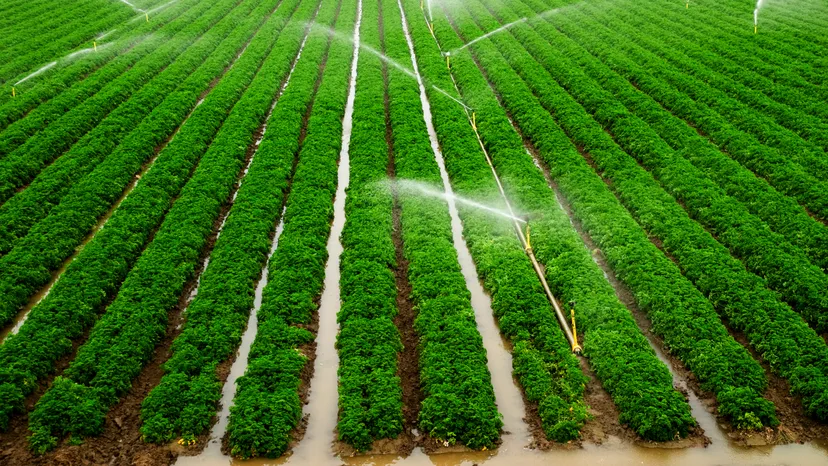
THE Government-facilitated and private sector-driven initiatives introduced by the Second Republic have led to a 60 percent surge in irrigation area from 171 000ha in 2020 to 274 440 hectares this July.
This comes against the backdrop of the looming “Super” El Niño weather phenomenon projected to occur during the 2026/27 farming season, with the Government intensifying the “Dam is an Economy” strategy.
Officially opening a public lecture organised by Zimpapers and its partners in Harare yesterday, Agriculture, Mechanisation and Water Resources Development Minister Dr Anxious Masuka said the Government was climate-proofing agriculture production at household and national level.
The public lecture ran under the theme: “Smart Harvest, Resilient Nation: Agriculture as Zimbabwe’s Climate and Economic Shield.”
Zimbabwe is climate-proofing agriculture production to ensure food and nutrition security against the constant threat of climate, with the country predicted to be drier in the coming years.
“At the household level, the Government is adopting the climate-smart Pfumvudza/Intwasa programme together with agro-ecological tailoring.
“Since inception, Pfumvudza/Intwasa yields have exceeded their conventional counterparts as a result of practising precision farming.
“Adoption of the Pfumvudza/Intwasa programme has seen a 254 percent increase in the number of plots from 3, 2 to 11, 4 million in the 2025/26 season,” he said.
The area rose from 202 037 to 713 078 hectares.
At the national level, Zimbabwe is advancing the Dam as Economy concept, taking advantage of the 10 600 dams in the country.
The Government is expanding irrigation development, with area under irrigation rising to 274 440ha currently from 173 000ha at the launch of the Accelerated Irrigation Development programme in 2020.
From 1980 to 2020, irrigation area grew 14 percent from 151 000ha to 173 000ha.
Dr Masuka said the agriculture sector had grown from a US$5,2 billion industry in 2020 to US$10,3 billion last year and was targeting to be US$15,8 billion by 2030.
Like other countries, Zimbabwe is affected by geopolitical developments in the world, as 20 to 30 percent of the world’s fertiliser passes through the Strait of Hormuz.
The Government has thus upscaled local fertiliser production and the use of organic fertiliser.
“Last year, the country’s Gross Domestic Product (GDP) grew by 8, 3 percent and agriculture was the top performer, growing by 28 percent.
“Of the 8, 3 percent GDP growth, agriculture contributed 2, 2 percentage points,” he added.
For the upcoming season, the Government is seized with correcting the health state of the soil as about 70 percent of the nation’s soils are acidic (pH below 4,8).
The Government will provide lime to correct this acidity and improve fertiliser uptake by plants and crop yield.
Dr Masuka said the 2026/27 season would be guided by the Agriculture Food Systems and Rural Transformation Strategy 2 under seven strategic pillars: Enhanced Strategic Grain Reserve, Accelerated Climate-Smart Production, Integrated Financing Architecture, Livestock Drought Mitigation, Enhanced Imports, Coordination, Early Warning Systems and Capacity Building Support.
He expressed appreciation to Zimpapers for creating a platform, which is spearheading the dissemination and communication of farming information to the public.
“And this podcast and everything that they are doing and launching shortly will go a long way in ensuring information reaches the populace on time. The disseminated information turns into an input for increased production and productivity,” he noted.
Zimpapers chief executive Mr William Chikoto said the public lecture came at a time when agriculture had become more than just a sector of the economy but a national resilience strategy, climate adaptation tool, source of livelihoods and a pillar of Zimbabwe’s food security and economic growth.
“It is our contribution to shaping the national conversation on the most pressing issue of our time, securing our food systems and economic future in the face of a changing climate.
“One of the greatest lessons of our time is that food security is no longer achieved solely through land or rainfall inputs; it is increasingly achieved through information,” he said.
Mr Chikoto said a farmer who receives weather intelligence on time makes better decisions.
“A farmer who understands market prices makes better investments and a farmer who knows when pests are spreading responds faster.
“A farmer who understands Government programmes accesses opportunities more effectively; in short, information has become a critical agricultural input.
“So as Zimpapers, we are here to play our part, with this particular lecture following under the Agribusiness Hub, where we have dedicated ourselves to providing information,” he said.
Zimpapers will on Monday launch an Agribusiness newsletter, a podcast and other agrinews platforms that we are going to be using to support the Government’s agriculture, economic and investment policies.
“We want policy to not remain just a speech, but to become a real action that becomes productivity,” he added.-herald