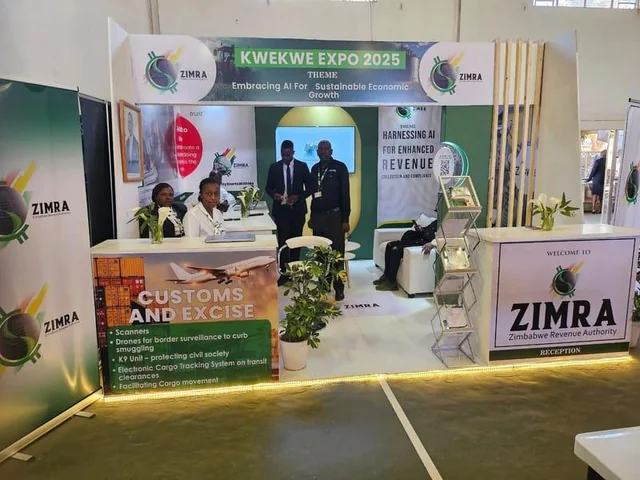
THE Zimbabwe Revenue Authority has called on Bulawayo businesses to ensure compliance with customs and excise regulations to avoid severe penalties, seizure of goods and prosecution.
This comes as crackdowns have been ongoing targeting illicit trade and smuggled goods to protect local industries, with authorities conducting inspections, imposing fines and closing non-compliant businesses.
Speaking at the recent tax education programme in Bulawayo, Zimra Bulawayo Customs Revenue Officer, Mr Thembinkosi Ndlovu, said customs duty was a levy collected on imported goods and services.
“Every importer is obliged to pay customs duty on dutiable goods and services. Customs duty is levied on private and commercial goods.
“For private importations, flat rates are used in duty calculation unless the importer elects to use specific rates of duty,” he said.
“While excise duty is charged on certain goods that are manufactured or produced within Zimbabwe.
“Every excise manufacturer shall be licenced by Zimra and this licence is valid for one year. No person shall manufacture excisable goods without a licence.”
On the calculation of duty, he said applicable rates are listed in the Customs Tariffs (Statutory Instrument 203 of 2022) and duty determination using flat rates depends on the nature of the goods being imported.
Giving examples, Mr Ndlovu said a television set attracts a 55 percent rate on the value of the set, while clothing attracts a rate of 40 percent plus US$3 per kilogramme.
“For commercial goods, appropriate rates of duty are used. The basis of calculation of duty in Zimbabwe is cost, insurance and freight.
“The commissioner has the right to revalue the goods, where he has reasonable grounds to believe that the goods were under-declared,” he added.
On rebate of duty, he said it was a waiver of duties and levies on imported goods and people are entitled to a traveller’s rebate on the value of goods amounting to US$200.
Mr Ndlovu said the rebate is granted to bona fide travellers once every calendar month and is only granted on non-merchandise goods.
“The rebate is granted on properly declared goods and is not aggregated. Crew members are not entitled to this rebate. On customs controls, the importation of certain goods is subject to controls.
“Zimra enforces controls on behalf of various Government agencies (for example, the Ministry of Agriculture and the Ministry of Industry and Commerce),” he said.
He said that to import controlled goods, the importer must have a licence/permit from the controlling authority, warning that failure to produce an import licence attracts a fine of US$2 000.
Differentiating between restrictions or prohibitions on the importation/exportation of goods, Mr Ndlovu said restrictions were subject to conditions laid down by the relevant authority.
On prohibition, he said the goods cannot be imported, even under licence, as they are banned, citing examples of motor vehicles aged 10 years and above and skin-lightening creams, among others.
“Customs offences include smuggling, false declaration of description and quantities, under declaration of value, deliberate misclassification, forgery of invoices and failure to adhere to import controls.
“Committing any of the above offences will result in the goods being seized.”
Mr Ndlovu said the seized goods may only be released upon payment of the correct duties and fines/penalties and submission of the relevant permits/licences.
He said, depending on the severity of the offence, the goods may be forfeited to the State and disposed of by way of rummage sale or appropriation.
“Individuals exporting goods for personal use out of Zimbabwe do not need to register a Bill of Entry or produce a CD1 form. A CD1 is an exchange control document that specifies that payment will be made to Zimbabwe. While commercial exporters need to register a bill of entry.”
He said generally, no duties are payable on export, but clearance fees are payable.
Mr Ndlovu said the documents that need to be attached to the bill of entry include Exchange Control CD1 forms, suppliers’ invoices, consignment notes and copies of Export Permits/Licences (where applicable).
“The exportation of certain goods is controlled. Exporters have to adhere to the requirements of the controlling authority before they can export goods from Zimbabwe.
“Examples of controlled goods are agricultural produce, livestock, minerals and currency,” he said.-herald