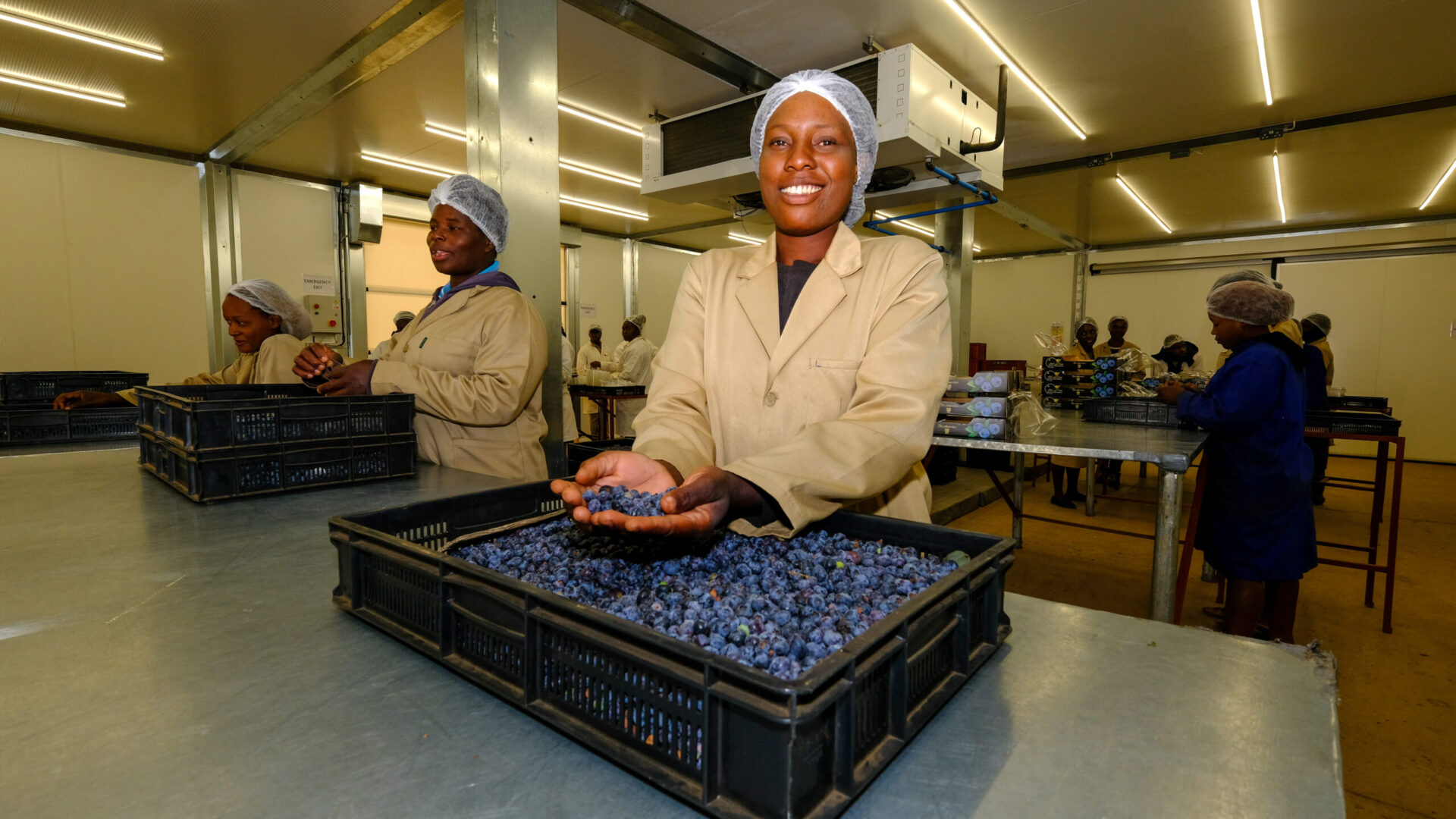
BERRIES export earnings surged by 34 percent from US$7,8 million in the nine months to September 2024 to US$104 million in the first three quarters of the year.
This growth coincides with the country’s efforts to tap into the lucrative Chinese market.
Statistics from the Zimbabwe National Statistics Agency (ZimStats) show that the country earned US$10,40 million from berry exports between January and September this year, compared to US$7,79 million during the same period in 2024.
In volumes, exports jumped 18 percent from 5 319 tonnes to 6 273 tonnes, while the average price rose by 13 percent from US$1,46 to US$1,66 per kilogrammes.
Berries are an emerging sub-sector within the horticulture sector that has been growing remarkably over the years.
The berries classification consists of cranberry, mulberry, blueberry, strawberry and raspberry with much of the growth attributed to blueberry.
The country recently signed a blueberry export protocol with China, which allows exporters to access the market subject to meeting the set sanitary and phytosanitary regulations.
“The milestone signing of the blueberry protocol with China in September did not happen overnight but was a result of many behind-the-scenes works, countless meetings and close coordination between stakeholders.
“Our growers will have access to one of the world’s fastest-growing blueberry markets, with Zimbabwe’s blueberry production expected to climb from 8 000 tonnes in 2024 to 12 000 tonnes in 2025.
“Our collective focus must now shift to scaling up investment through supportive policies and ensuring quality compliance,” said Horticultural Development Council (HDC) chief executive Mrs Linda Nielsen.
Driven by the trend towards healthy lifestyles, China’s blueberry imports have surged from just 665 tonnes in 2005 to nearly 39 000 tonnes in 2024, mainly sourced from Peru and Chile.
“The entry of Zimbabwean blueberries, known for their unique taste and texture, brings a new source of supply to that market,” she said.
Zimbabwe offers unique climatic conditions that give its berries a distinct advantage in size, flavour and texture. This makes them popular in many markets around the world. Blueberries are rich in antioxidants. They are also low in calories and high in vitamins C and K, making them a key part of a healthy diet.
Zimbabwe’s blueberry harvest season runs from May to October.
“Our early-season window gives local growers a competitive edge, allowing them to enter global markets ahead of other producers,” she said.
Currently, blueberries are being produced in several areas in the three Mashonaland provinces and Manicaland.
“Overall, Zimbabwe has very good climatic conditions for high-quality berry production.
The majority of Zimbabwe’s produce is transported by air, with producers always looking at the most viable routes to market, Mrs Nielsen said.
HDC board member and blueberry farmer, Mr Willard Zireva, recently said market connections mattered for a thriving export business.
“What transformed my business was not just better farming techniques, it was understanding market requirements and building linkages.
“When I started focusing on what the market actually wanted, and not just what I could grow, everything changed,” he said.
Mr Zireva said he had been in horticulture production since 1993, starting with mangetout peas and later into the lucrative blueberry, but his growth had been hindered by access to finance, power and water supply.
“Blueberry is only irrigated during the day and not at night and any load shedding during the day negatively affects us growers as we are forced to use expensive diesel-powered electricity generation methods.
“One hectare of blueberry has 4 000 plants in pots and each plant requires five litres of water per day, a total of 20 000 litres,” Mr Zireva said.
Mr Zireva has been stuck on 12 hectares for several years, due to limited water availability, but plans to grow the planted area to 50 hectares.-herald