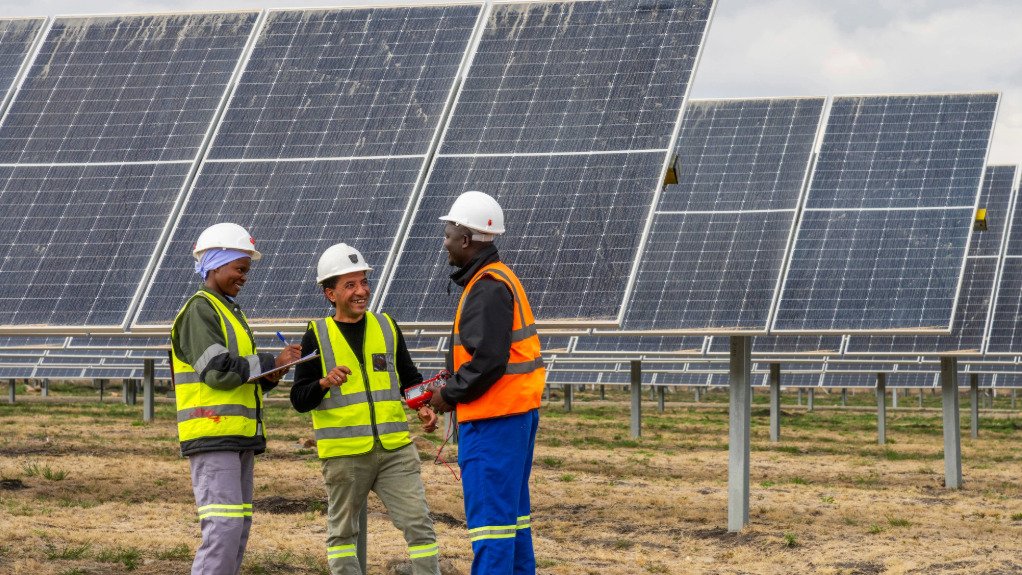
Platinum producer Zimplats has announced it has begun construction of its US$54 million Phase 2A, 45-megawatt solar power plant, as part of its ongoing drive to achieve energy self-sufficiency and reduce reliance on the national grid.
According to the company’s quarterly report for the period ended September 30, 2025, Zimplats spent US$12 million on the project during the quarter, with an additional US$36 million already committed. The plant is scheduled for completion in the first half of 2027 and will take Zimplats’ total installed solar generation capacity to 80MW once operational.
This new development follows the successful commissioning of the Phase 1A, 35MW solar plant in August 2024, which marked a key milestone in the miner’s renewable energy strategy.
Solar investment forms part of Zimplats’ broader sustainability programme aimed at ensuring a stable power supply to its operations while reducing carbon emissions. Zimplats’ multi-phase solar rollout aligns with Zimbabwe’s national energy strategy, which seeks to diversify the power mix through renewable energy investments.
The expansion is expected to improve energy security for the company’s mining and smelting operations and also contribute excess power to the national grid in the long term.
“Following the successful commissioning of the Phase 1A 35MW solar plant in August 2024, the Company commenced implementation of the Phase 2A 45MW solar plant in the quarter. The project is expected to be completed in the first half of 2027 at a total project cost of US$54 million and will increase total solar power generation to 80MW. A total of US$12 million had been spent and a further US$36 million committed as of 30 September 2025,” Zimplats said in the quarterly report.
The initiative could set a benchmark for other large-scale miners looking to mitigate the impact of power shortages on production.
In recent times, several leading mining firms have taken steps to invest in energy projects, with a substantial focus on renewable energy solutions.
These initiatives have so far been pivotal in alleviating the pressure on the country’s main power utility, which still struggles to meet the growing energy demands of the mining sector. One of the prominent examples is Caledonia Mining’s Blanket Mine’s successful commissioning of a solar plant with a capacity of 12.2MW in 2023 at a construction budget of approximately US$14 million.
Turk Mine in the Bubi District launched a 4.4MW solar farm which is currently powering its mining operations effectively. Prospect Lithium Zimbabwe (PLZ) has also begun the process of constructing a 70MW power station, a strategic move aimed at augmenting local power supply.
Cement producer, PPC Zimbabwe, has also hinted at establishing two solar power plants valued at US$40 million. These plants will have a combined capacity of 30MW, with one facility located in Colleen Bawn generating 20MW and the other in Bulawayo generating 10MW.
Meanwhile Zimplats continues with the development of Mupani Mine, which aims to replace the depleted Rukodzi and Ngwarati mines. The project has a target to achieve a full-scale production of 3,6 million tonnes per annum in the 2029 financial year.
As of 30 September 2025, a cumulative total of US$352 million had been spent on this project against a total project budget of US$386 million.
In terms of performance in the quarter under review, Zimplats’ mined volumes decreased by one percent from the prior quarter and remained constant year-on-year.
On the other hand, depletion of ore from mine pillar reclamation at the high-grade Rukodzi Mine, coupled with production from lower-grade ore at South Pit, resulted in a two percent decline in 6E head grade from the prior comparable period, while higher volumes of development tonnage from Bimha and Mupani mines resulted in a one per cent decrease from the prior quarter.-herald