RESTORING confidence remains the cornerstone of the country’s Monetary Policy framework, while trust in the local currency cannot be legislated, but must be earned through sustained macro-economic stability and consistent policy implementation, the Reserve Bank of Zimbabwe has said.
Responding to questions from Members of Parliament after presenting the Monetary Policy Statement (MPS) to them yesterday, RBZ Governor Dr John Mushayavanhu said Zimbabwe had entered a more stable macro-economic phase, characterised by subdued inflation, a steady exchange rate and a policy rate that had remained unchanged for more than a year.
“Confidence cannot be legislated, but it can be driven by stable inflation and a stable currency,” Dr Mushayavanhu said.
“If we continue on this trajectory, we will build confidence and ultimately have an exchange rate that is market-determined.”
Zimbabwe’s inflation, measured in the Zimbabwe Gold (ZiG) currency, declined to 3,8 percent year-on-year in February 2026, from 4,1 percent in January.
This marked the first time in nearly three decades that domestic currency annual inflation has fallen to single digits.
The annual rate peaked at 95,8 percent in July last year, before progressively declining to single digits.
The ZiG, introduced in 2024 and backed by gold and foreign currency reserves, continues to see growing stability, with exchange-rate volatility having moderated, while the premium between official and parallel market rates has narrowed significantly to about 20 percent.
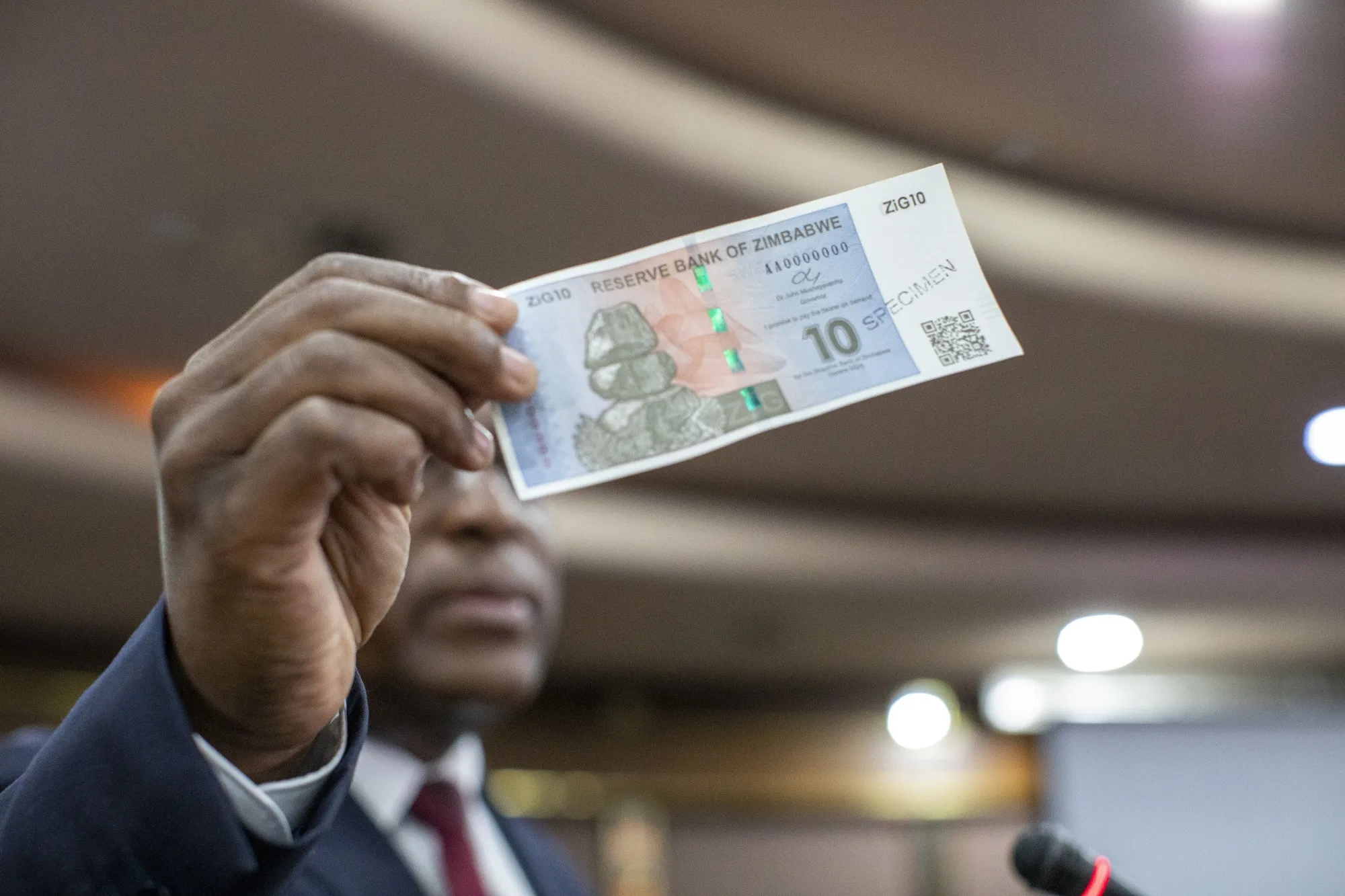
Dr Mushayavanhu told legislators that to further improve cash availability and circulation, the central bank has introduced a new series of banknotes. These include upgraded ZiG10, ZiG20 and ZiG50 denominations, which will enter circulation on April 7, 2026.
Higher denominations ZiG100 and ZiG200 will be introduced as the bank deems necessary. The existing ZiG10 and ZiG20 notes will remain legal tender alongside the new series.
In the MPS, the Governor announced several policy interventions aimed at reinforcing currency and price stability while boosting market confidence. These include a reduction in bank charges and refinements to the foreign exchange trading regime.
Dr Mushayavanhu said the RBZ’s primary focus remained to safeguarding the stability of the ZiG and anchoring inflation expectations.
He told the legislators that the central bank has maintained a tight, but consistent policy stance, with the policy rate held at 35 percent for over a year, providing predictability to the market.
“The sustained stability has helped contain price pressures and anchor expectations,” he said.
“We have seen a very stable interest rate at 35 percent for over a year now. We have seen stable prices. We have managed to reduce inflation and continue to improve the quality of life.”
Dr Mushayavanhu said that authorities would continue to prioritise price stability as a prerequisite for rebuilding trust in the local currency, adding that policy would remain proactive rather than reactive.
“We will continue to work on improving confidence in the local currency, riding on the stable environment that we are now seeing,” he said.
He noted that improved stability has allowed contracts to continue being denominated in currency value, signalling the gradual restoration of money’s unit-of-account function.
“We used to be in hyperinflation, where if you introduced a note today, before the end of the month, that note would no longer be binding. Now, with the stability we are seeing, money continues to carry value.”
To illustrate this point, Dr Mushayavanhu cited the stability in basic commodity prices, noting that bread prices have remained unchanged for an extended period, a scenario that was previously unthinkable.
“In January 2024, bread was at ZiG32 and it is still maintained at ZiG32,” he said.
“That stability in money is what we want to ensure so that the currency remains viable.”
Addressing concerns raised by MPs about low financial intermediation and the tendency by households and businesses to keep cash outside the banking system, Dr Mushayavanhu said the issue remained a key concern for the central bank.
“The issue of people keeping money in deposit boxes or under beds worries us,” he said, adding that the RBZ had engaged banks to address one of the major deterrents to banking, which include high charges.
He said banks have reduced fees, while deposit interest rates have been adjusted to ensure savers earn real positive returns.
The Governor applauded banks for exempting accounts with balances of US$100 and below, or the ZiG equivalent, from monthly service fees and for waiving charges on transactions of US$5 and below, or the ZiG equivalent.
Banks have also agreed to scrap charges for account balance inquiries.
“These reforms were informed by public consultations, where consumers complained that bank charges were eroding their savings,” he said.
Dr Mushayavanhu said increased use of the banking system would allow savings to be channelled into productive sectors of the economy, supporting growth and reinforcing stability.
“If money is in the bank, it can be used to benefit the economy,” he said. “I don’t see any reason why anyone would want to keep money in a vault when you can earn a good return from the bank.”
On the transition to a mono-currency system, the Governor stressed that rebuilding and regaining confidence in the domestic unit would remain a key precondition.
He said authorities would not force economic agents to abandon foreign currencies but would instead focus on increasing demand for the local currency through stability and reserve accumulation.
“We are not going to force people into mono-currency, we want to increase demand for the local currency and build reserves from the current 1,5 months of import cover to at least five to six months,” he said.
He said the ultimate goal was a situation where economic agents willingly accept payment in local currency without hesitation.
Dr Mushayavanhu said even under a mono-currency framework, policy would remain market-oriented, with foreign currency contracts honoured in the currency in which they were contracted, including foreign currency-denominated loans.
He said the RBZ and Treasury were working to broaden the revenue base, including within the mining sector, to ensure reserve sustainability and strengthen policy credibility.-herald