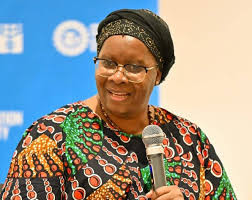
UNITED Nations assistant secretary-general and UN Women deputy executive director Nyaradzai Gumbonzvanda has challenged Zimbabwean local authorities to take the lead in establishing and scaling up safe, dignified markets for women traders, saying the idea is achievable if backed by political will.
Gumbonzvanda made the remarks last Friday during a Press conference following a high-level UN Women mission to Zimbabwe, where she visited markets and held engagements with government officials alongside East and Southern Africa deputy regional director Adama Moussa.
She visited the UN Women-sponsored safe market in Epworth and recommended it as a practical example that can be replicated nationwide.
The UN Women’s safe market projects, established in Epworth and Umzingwane in Bulawayo, are designed to provide a secure environment for children accompanying their mothers in marketplaces.
The safe markets have children’s learning areas and play centres to ensure their safety and care as their mothers are conducting business at the market.
Advertisements
Gumbonzvanda stressed that local authorities hold the key, particularly, in urban areas, by allocating designated land and ensuring proper planning for markets rather than allowing informal, unsafe trading spaces to proliferate.
“It is very possible to go to scale. It’s a question of political will to make it happen,” she said.
“What does political will look like? First, local authorities can give designated land and properly plan within that land.
“We saw this with the Epworth board, where land was specifically made available for women on the market.”
Gumbonzvanda said markets should be understood not merely as trading points, but as centres of health, dignity and community well-being, especially for women who dominate the informal economy.
She highlighted the need for basic infrastructure such as clean water, sanitation and ablution facilities, noting that absence of these compromises food safety and women’s dignity.
“If a market does not have sanitation and water, then our tomatoes are affected.
“Women need toilets. Women need water. They need a decent place where they can wash their hands, pack their produce and serve clients.
“So the women’s market is a very critical space and I believe that Zimbabwe can scale up. What is needed are resources, so any local authority, any, they are able to budget towards that. And this is also an opportunity of public-private partnerships.
“As we were there at Epworth market, I was looking at those steel sheets and I thought the private sector can actually come in and offer some of these materials, and by so doing marketing the products that they have put in.”
Gumbonzvanda added that safe markets should also recognise women’s care responsibilities, applauding facilities that integrate child care and shared care services within market spaces.
Beyond infrastructure, the UN Women deputy executive director called for better economic valuation of markets, arguing that governments often underestimate their contribution to income generation, food security and economic stability.
“There’s not enough quantification to say how much is generated on the market to uphold livelihoods and community economies,” she said.
“We were discussing experiences elsewhere like Nigeria. Women on the market are earning millions.”
She described women’s markets as powerful social and political spaces, where women exchange support, build confidence and even mobilise for leadership.
“The market for women is more than just a market.
“It’s a social space, a space for peer and psychosocial support, and a place where women negotiate power, even political power within their communities.” -newsda