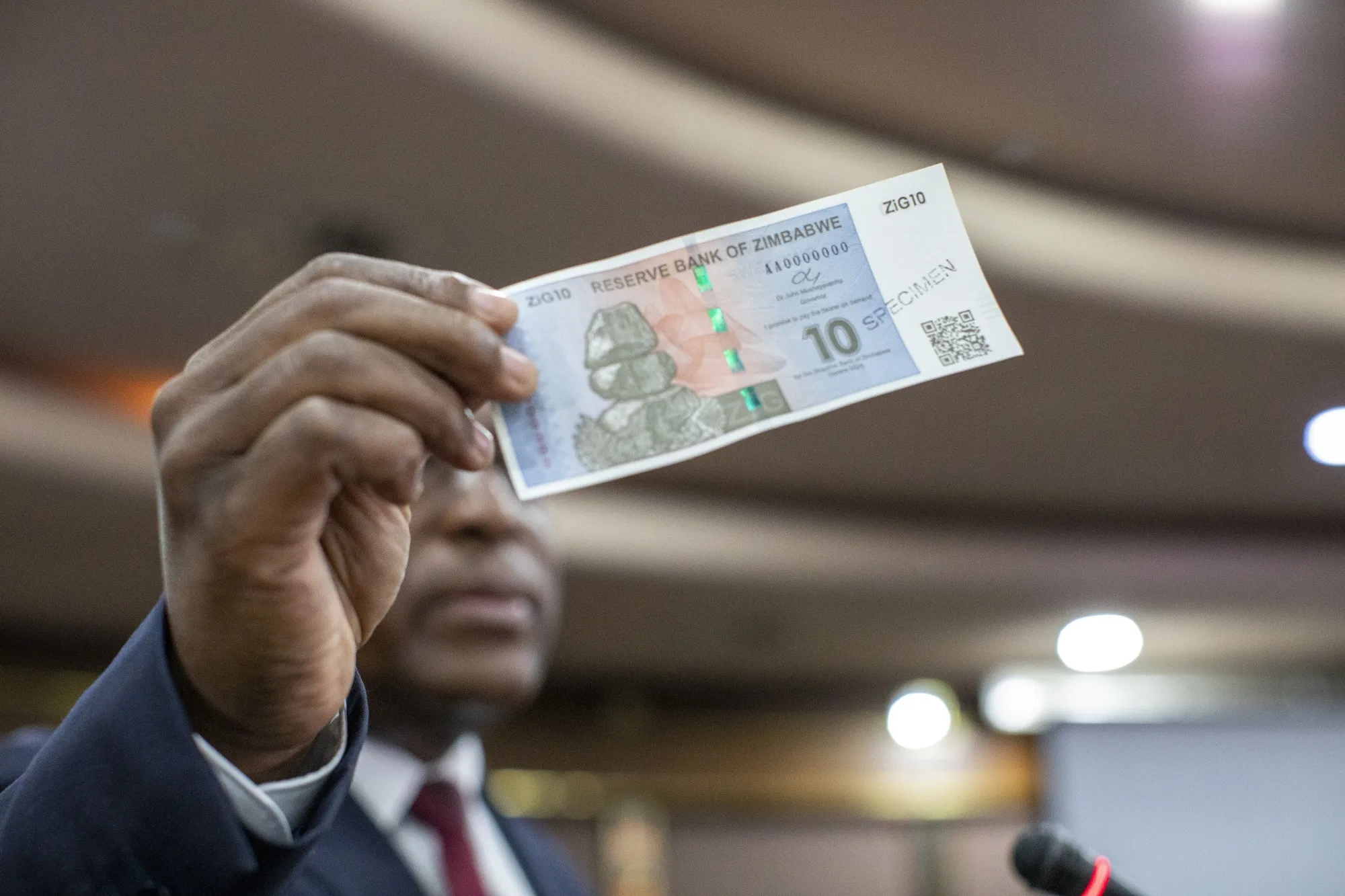
THE Reserve Bank of Zimbabwe (RBZ) on Friday presented sweeping monetary policy measures, defending its tight monetary stance, as it announced extensive cuts on bank charges, introduced a new series of ZiG banknotes and threatened a crackdown against errant mobile network operators.
The policy statement signalled a fundamental shift in how the bank will approach the gradual transition to a mono-currency system and detailed several adjustments and interventions to refine and support the current policy framework.
Presenting the policy statement at the central bank in Harare, RBZ Governor, Dr John Mushayavanhu, briefed stakeholders on the bank’s wide-ranging agenda that balances technical monetary interventions with aggressive consumer protection measures and a clear roadmap for Zimbabwe’s transition towards a domestic monocurrency.
Rate hold defended
Despite the annual ZiG inflation falling to 3,8 percent in February from 4, 1 percent in January, Dr Mushayavanhu pushed back strongly against calls to immediately lower the bank policy rate.
The rate was maintained at 35 percent, treading cautiously to avoid undoing recent gains, which have seen inflation drop to record lows in nearly three decades while the exchange rate has remained stable.
“You might ask: if inflation was 4,1 percent in January and is 3,8 percent now, why are you also not lowering the policy rate?” the Governor rhetorically asked.
“The argument is very simple. We need, first of all, to ensure that we have anchored inflation expectations.”
Drawing on a medical analogy, Dr Mushayavanhu warned against celebrating too early.
Reserve Bank of Zimbabwe
“If you go to a doctor and they give you medication, most often after a day or two, you start feeling better. But the medication will last for a week, if not two weeks,” he said.
“If you stop taking that medication, when the ailment eventually comes back, it will be more serious than before.”
Dr Mushayavanhu pointed to the European Central Bank and the Bank of England as examples of institutions that maintained elevated rates even after inflation began to subside, to entrench low inflation expectations.
Bankers voluntarily slash fees
In what Dr Mushayavanhu described as a landmark move, commercial banks have voluntarily agreed to reduce several transaction fees.
Cash withdrawal fees have been capped at two percent, down from three to four percent, while point of sale charges are now capped at 1,5 percent from three percent.
Discover more
Sports fan merchandise
Arts entertainment event tickets
Made in Zimbabwe branding
Balance inquiry fees have been eliminated, along with certain cash deposit charges.
Transactions between zero and five dollars will not attract bank charges, while balances below US$100 or equivalent will incur no service fees.
New ZiG banknotes from April 7
A statutory instrument published on Friday ushers in the new series of ZiG banknotes, the bulk of which will begin circulating from April 7, 2026.
The new series comprises ZiG10, ZiG20, ZiG50, ZiG100 and ZiG200 denominations, which will circulate alongside existing ZiG10 and ZiG20 notes.
The ZiG100 and ZiG200 will only be introduced as and when the central bank deems fit.
Dr Mushayavanhu emphasised that the old and new notes will remain legal tender and circulate side by side with the new ones.
Banks will gradually withdraw worn notes from circulation, returning them to the central bank for destruction and replacement.
Discover more
Online news subscription
Export visibility services
National news aggregation
An extensive public awareness campaign will run until the launch date to familiarise citizens with the new notes’ security features.
MNOs June deadline
In the stern warning to mobile network operators, Dr Mushayavanhu gave the mobile telecom companies until the end of June to clean up their customer databases in collaboration with the Registrar General’s office.
“We cannot have an environment where people are laundering money through mobile money accounts, that we will not allow,” he warned.
The zero-to-five-dollar fee-free regime for banks has been extended to MNOs, with Dr Mushayavanhu inviting the public to report violations.
“We will revoke MNO’s licence to offer payment services,” he said.
Dr Mashayavanhu said the “nano-loans” offered by MNOs must now be underwritten by commercial banks and should be supported by a balance sitting on bank balance sheets.
“Imagine a mobile network operator with 10 million subscribers and they give each one 10 dollars. That’s 100 million US dollars that they will have created, not backed by deposit, not backed by anything,” Dr Mushayavanhu said, illustrating the systemic risk.
Discover more
Drug addiction recovery programs
Television streaming services
Newspaper delivery service
Conditions precedent for 2030 mono-currency transition
In a fundamental philosophical shift, the RBZ has moved away from a fixed 2030 timeline for transition to a mono-currency regime, replacing it with a “conditions precedent’ approach.
“We are not talking about 2030 anymore. We are talking about conditions precedent for us to achieve mono-currency,” said Dr Mushayavanhu.
The two conditions are durable economic stability with sustained single-digit inflation and foreign currency reserves equivalent to three to six months of import cover.
While January and February both recorded single-digit inflation, Dr Mushayavanhu cautioned that two months do not constitute durability. Import cover currently stands at 1,5 months, up significantly in less than two years, but still short of the target.
Crucially, the transition will be market-driven.
ZiG
“You’ll find that when you go into mono-currency, you won’t be told. You are the ones who will be indifferent as to whether a person pays you US dollars or ZiG, you won’t mind,” Dr Mushayavanhu said.
When asked whether 2028 might be possible for a switch to domestic mono-currency if conditions are met, the Governor replied: “Why not?”
Money supply collapses
Dr Mushayavanhu presented data showing a dramatic deceleration in money supply growth, which has fallen to 2,7 percent in 2025 from over 40 percent in prior years.
He attributed this directly to the tight monetary framework introduced following the ZiG’s launch in April 2024, including the September 2024 policy rate hike from 20 percent to 35 percent.
Discover more
Connectivity problem solutions
Web development services
Zimpapers publication access
The central bank has also introduced an “optimum liquidity level” based on historical transaction data, against which the market has continuously traded.
Addressing complaints about cash shortages, the governor revealed that the banking system holds an excess of ZiG2 billion daily, suggesting the issue is not one of aggregate liquidity but of distribution.
Statutory reserves clarified
Dr Mushayavanhu corrected what he described as a widespread misconception regarding statutory reserve requirements.
“So, it is not true that statutory reserves are 30 percent. They are 15 percent,” he stated firmly.
The two-tier system — 30 percent for demand deposits and 15 percent for time and savings deposits — is designed to incentivise banks to cultivate a more stable deposit base.
“If banks can attract savings and time deposits, they should be able to lower their statutory reserves to 15 percent,” the Governor explained, linking stable deposits to the ability to extend longer-term lending.
Export surrender maintained, small-scale miners brought in
The RBZ has retained the 30 percent export surrender requirement for most exporters, citing rising commodity prices that will deliver increased foreign currency even with unchanged export volumes.
In a significant policy shift, small-scale gold miners will now be required to surrender 10 percent of their earnings, gradually bringing them into the formal framework.
“Do you remember when I first came in, I said this is not my farm where some animals are more equal than others,” Dr Mushayavanhu said, explaining the move to close arbitrage loopholes where large-scale miners were marketing gold through small-scale channels.
Algorithm-based forex trading system
The central bank is developing an algorithm-based electronic foreign exchange trading system to automate price discovery and remove manual intervention. The system will match orders anonymously, with counter-parties revealed only after trades are executed.
Currently, undergoing user acceptance testing with commercial banks, the platform will be subjected to validation by an unnamed international organisation before going live.
“We are not just going to say we have developed it on our own and it’s OK. We want the system to be validated,” Dr Mushayavanhu.-herald