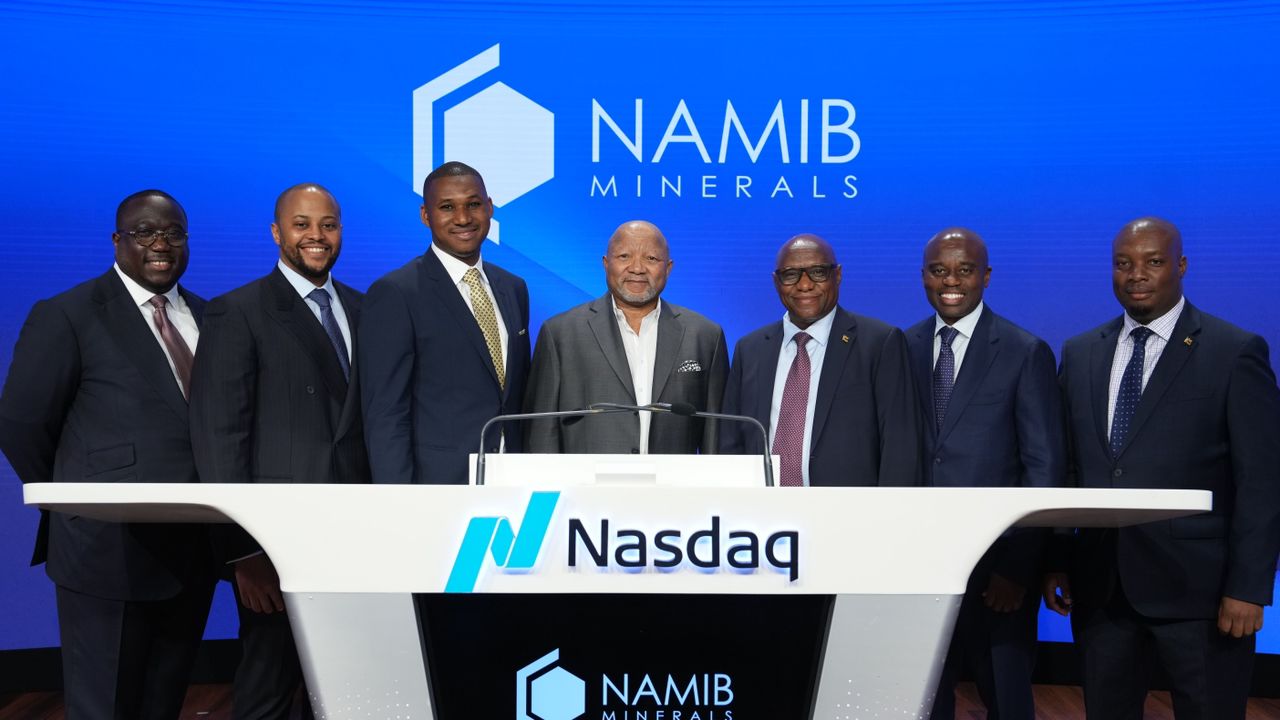
NASDAQ-listed Namib Minerals needs between US$300 million and US$400 million to finance its multi-asset expansion programme in Zimbabwe.
This comes amid strong investor interest in Zimbabwe’s mining sector, driven by diverse and abundant mineral resources, including a global boom in lithium demand and strong platinum and gold prices.
The Government’s “open for business” policy approach, investment in key infrastructure and strong projected economic growth rates further signal confidence and attract investment from local and international players.
A long period of economic stagnation also presents attractive opportunities for lucrative investments across key sectors of Zimbabwe’s economy, such as mining.
The bulk of Namib Minerals’ planned capital investment is earmarked for the restart and development of Redwing Mine, where the company plans to complete a feasibility study, dewatering the mine, upgrading surface infrastructure and increasing production capacity.
The mining group is pursuing a balanced funding mix, incorporating debt, structured financing, strategic partnerships and internally generated cash flows to fund planned projects while minimising shareholder dilution.
Namib Minerals is currently engaged in discussions with multiple capital providers, although the final funding envelope remains subject to feasibility studies, engineering results, market conditions and equipment procurement costs.
The company has commenced enabling works at Redwing, with dewatering operations scheduled to start during the feasibility study phase and expected to take around eight months to reach the targeted mining levels.
Dewatering is a critical first step in the restart sequence, allowing the company to assess underground conditions, refurbish infrastructure, and prepare for a phased production ramp-up.
The company is planning to concurrently fix surface infrastructure, power supply upgrades to align with the restart timeline.
At Mazowe Mine, the company is progressing with surface infrastructure upgrades, including power, water and tailings management systems, while detailed engineering studies continue to refine the restart plan and improve capital efficiency.
Meanwhile, at How Mine, Namib Minerals is pushing ahead with an expansion to increase milling capacity from 40 500 tonnes per month to 55 000 tonnes, a 36 percent uplift.
Procurement of the required processing equipment is currently in progress at How Mine, with the expansion expected to come online in the second half of 2026.
This increased capacity will enable the company to process higher ore volumes and offset the reduction in grade experienced to date in 2025.
Currently, the company is advancing a three-pillar growth strategy broken down as operational excellence at How Mine, strategic restarts of Mazowe and Redwing mines, and portfolio diversification through critical minerals exploration.
Mazowe and Redwing have been on care and maintenance since 2019 and 2020, respectively, but are now being repositioned for a structured restart.
“We are focused on building Namib Minerals into a multi-asset,mid-tier producer through operational optimisation at How Mine and the disciplined restart of our Mazowe and Redwing mines.
“Our engagement of WSP for comprehensive feasibility studies, combined with the commencement of enabling works at Redwing and capacity expansion initiatives at How Mine, demonstrates tangible progress toward our vision.
“We look forward to updating the investment community on our strategic roadmap and near-term milestones,” said Namib Minerals Chief Executive Officer Mr Ibrahima Tall.
Namib Minerals reaffirmed its long-term ambition to evolve into a multi-asset, mid-tier gold producer, ultimately targeting 300 000 ounces of annual production.
It emphasised that the figure represents a long-term corporate objective and is not based on a Preliminary Economic Assessment, Pre-Feasibility Study, or Feasibility Study.
According to Namib Minerals realisation of this target depends on the successful execution of mine restarts, capacity expansions, and wider exploration and development programmes.-herald