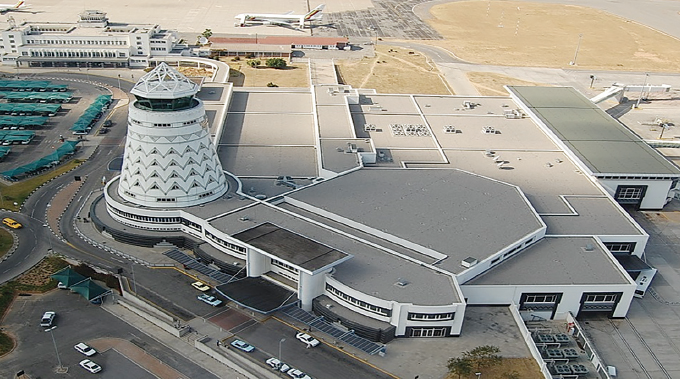
TRANSPORT and logistics firm, Transvaal Africa, is investing slightly over US$1 billion to develop a trade-transformative cargo village at Robert Gabriel Mugabe International Airport in Harare.
The smart city facility, encompassing all logistical services, including grading, sorting and packaging, will be implemented under a public-private partnership with the Airports Company of Zimbabwe (ACZ).
Transvaal’s project is a perfect fit for ACZ’s vision and plans to develop RGM International Airport, Zimbabwe’s biggest aviation terminal, into a regional hub of passenger and cargo services.
ACZ envisions integrated cargo facilities at the airport, given that the current cargo operations are fragmented, with people operating from different places.
Ideally, every airport should have a cargo terminal building where everyone is housed under a single roof, which improves efficiency and turnaround times for aircraft.
Transvaal’s smart city facility will become a cornerstone of global commerce at the RGM International Airport. The facility will be designated a Special Economic Zone (SEZ).
SEZs are geographical areas within a country offering different, more liberal economic regulations, tax breaks (like tax holidays, customs duty relief, easier forex) and streamlined processes.
Expectations are high that the logistical facility will boost Zimbabwe’s trade capabilities and attract worldwide investment with its cutting-edge infrastructure and investor-friendly policies.
According to Transvaal Africa, central to the Cargo Village will be its cold chain facilities, designed to support agro processing and logistics in a climate-controlled environment.
These specialised units will ensure the preservation of perishable goods, enabling local farmers and exporters to take their high-quality products to markets worldwide, while minimising waste and maximising profitability.
President Mnangagwa
Transvaal Africa chief executive officer (CEO) Engineer Patson Moyo said the company planned to do the groundbreaking for the project in the first quarter of next year.
“So far, we have completed all the regulatory issues. We have now got our approvals, environmental approvals. We are now waiting for the final one, which is from the local Government and is almost done in terms of permits.
“And we are also aligned with our partners, both outside and local. So, we are expecting to have groundbreaking in the first quarter of 2026.”
“The total cost of the project is US$1 billion and 50 thousand. We have financial partners from outside and also local partners.
“It’s going to be the first of its kind in Zimbabwe; the project will start with the runway, then the terminal, the warehousing and then other amenities,” said Eng Moyo.
“The hub that we are creating is a conduit for exports. Zimbabwe is quite strong in minerals and agriculture, and now the drive is to push agriculture. We are performing well in horticulture, but what is lacking now is the complete plan for exports, the value chain.
Transvaal Africa chief executive officer (CEO) Engineer Patson Moyo
“So, this project will be a game-changer and a solution provided to all. It will push up the value chain and, as the President said, ‘no one will be left behind’. It will make everyone in rural areas and commercial areas participate in this economic build-up for the country,” he said.
Eng Moyo said the project followed trends globally, which entail developing airports into commercial hubs. Closer to home, this is happening in Ethiopia, one of East Africa’s largest economies.
“There is a big investment in Ethiopia. They are also developing their airport in Kenya. They are developing it into a commercial hub. It has also started in Dubai. It is where the heart of the commerce is.
“So, with us as a landlocked country, we are looking at where we can maximise, and it came to be the airport, with the drive that they had of developing the passenger side,” Eng Moyo said.
He said in line with President Mnangagwa’s economic development philosophy, “Nyika inovakwa nevene vayo/ Ilizwe lakhiwa ngabanikazi balo”, at least 40 percent of the construction works will be carried out by local firms.
“We are keeping 40 percent of the construction work for the local contractors. And obviously, there is work that needs speciality, that needs international companies that have done it before; the experienced companies.
“Works like putting down the runway, all the technical issues, they are not available locally, they are with international companies. As to how many people will be employed, directly, at least about 3 000 people will be employed with this project.
“Then indirectly, there are so many spin-offs that are going to be engaged, and it can go up to about 10 000.”
Transvaal’s investment aligns with the Government’s recent investment at RGM International Airport to the tune of $153 million, which added a new terminal, aprons and infrastructure to boost capacity.
ACZ CEO Mr Tawanda Gusha said the state aviation infrastructure company and the Government of Zimbabwe always had plans to develop RGM International Airport into a regional hub for passenger and cargo services, including, but not limited to, aircraft maintenance, to become a total package for aviation services.
“So, in terms of capacity, we are going to ensure that we increase the current capacity. Our estimates are that we are probably going to increase it by three, four, or five times the current cargo capacity.
“And this development is also going to attract other light industries closer to the airport, so that whatever light manufacturing that can be done can then be done, particularly when it comes to the ICTs and the like, so that it’s closer and easier to manufacture those and just transport them to the airport.
“Also, one of the underlying plans is for us to apply for that area to be designated as a special economic zone, so that trading and investment in that zone becomes more attractive.”
Transvaal’s smart city cargo village, Mr Gusha said, would complement ACZ’s ongoing infrastructure expansion and modernisation, including the planned runway extension, which is now part of the cargo village project.
“The secondary runway has always been planned for that airport. And you can go as far back as 1971, when the local subject plan number 31 was first published. But of course, it was further revised in 1994 and 1996.
“So, that secondary runway will then be ideal because it will then be serving the cargo terminal building. But at the same time, we’ve, over the past couple of years, had a couple of incidents where we disabled aircraft on the runway, and we had to close the runway for a period of time.
“We were even diverting some of the aircraft to neighbouring countries or to different airports, which in itself brings serious inconveniences to the travelling public, as well as to the airlines.
“So, the secondary runway will then come in to plug in that gap, so that whenever one of the runways is not operating, we have a secondary runway to turn to, so that we don’t affect operations.
“And at the same time, we’re also anticipating growth in passenger numbers. We’re also anticipating growth in the number of airlines that we’re going to be handling going forward, because we have also adopted an aggressive strategy to bring in more and more airlines to grow the business in and around Robert Gabriel Mugabe International Airport and the country at large.”
While OR Tambo is the giant in the region and on the continent, and serves as an inspiration for the heights Zimbabwe wants to reach, Mr Gusha said the ultimate objective was to make Zimbabwe a regional aviation hub that outcompetes other key airports in the region, such as King Shaka in Durban, Lusaka International Airport in Zambia and other aviation centres in Beira and Maputo, Mozambique and Botswana.
“So, that is the reason why we want to develop Robert Gabriel Mugabe International Airport into a regional hub. The strategic advantage we have is our location, where you find that there are plenty of airports around, and your flights are within two hours of each other.
“You can then consolidate that cargo, bring it in, and then ship it out to Europe, the Middle East, and beyond. So, that’s why we want to develop Harare as a cargo hub and as a transit hub, so that we bring in that cargo on a two-hour flight.
“A two-hour flight is not that long, so then you take them on to do the long flights to Europe and the Middle East and the Far East,” he said.-herald