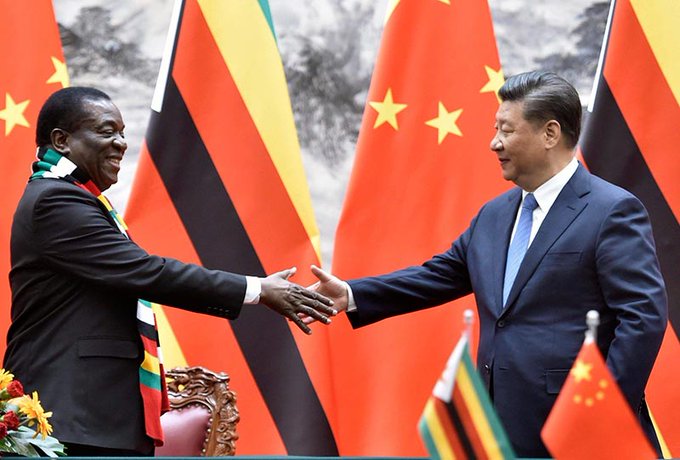
INDUSTRY leaders want negotiations for a new trade agreement with China to cover crucial issues, including skills and technology transfer, value addition and beneficiation of minerals and agro-processing.
These sentiments emerged during a private sector consultation on the Zimbabwe-China trade agreement in Bulawayo yesterday, organised by the Confederation of Zimbabwe Industries (CZI), the country’s most influential industrial lobby.
Zimbabwe is negotiating and deepening trade agreements with China, with a focus on expanding trade, enhancing economic cooperation and creating frameworks for tariff reductions.
The Confederation of Zimbabwe Industries (CZI) is leading the consultations with the private sector to develop a national position on a proposed Framework Agreement and a “draft tariff offer” with China.
Zimbabwe and China enjoy cordial socio-economic and political relations dating back to the period of Zimbabwe’s struggle for independence from Britain.
Last year, the two countries elevated their bilateral relations to an “ all-weather community with a shared future,” strengthening ties across political, economic, and security sectors.
In 2025, Zimbabwe-China trade reached a record US$4,39 billion, with a US$720 million trade surplus in favour of Harare after exporting US$2,56 billion in goods (largely tobacco and minerals) and importing US$1,84 billion in machinery and technology.
Industrialists said there was a need to consider non-tariff issues, such as sanitary and phytosanitary measures and technical trade barriers, which present serious challenges for exports to the Chinese market.
CZI trade and research economist Ms Perpetua Muzondo said SPS and TBT issues affect producers of fresh produce, as the use of certain chemicals is inevitable despite being banned in other markets.
She said, besides fumigation, the Chinese market required suppliers to keep their produce under certain conditions in cold facilities, which may be too expensive given the period that the conditions must be maintained.
“Local businesses might view this as an opportunity to address non-tariff barriers that continue to constrain our local businesses from effectively exporting to the Chinese market.
“We have some SPS and TBTs that we are facing when we are trying to export,” said Ms Muzondo.
“These are issues which we are hoping for, if we sign this trade agreement, if we negotiate properly, these issues may be addressed. So, the negotiation team, we are hoping that when you are going to negotiate, these are issues that need to be raised so that we can export our agricultural products.”
Ms Muzondo said authorities should promote local services to international investors, as this can boost local industries and create employment.
She also called for special consideration of skills and the need for technology transfer by Chinese investors to reduce the number of technical experts they bring into Zimbabwe.
To enhance economic cooperation, particularly in the fields of industrialisation and trade, the Government of Zimbabwe and the Government of the People’s Republic of China agreed to negotiate an Economic Partnership Agreement for Shared Development.
As a result, the two countries signed a Framework Agreement in September 2024 to guide negotiations for the aforementioned Agreement.
According to the Competition Tariffs Commission (CTC), Zimbabwe-China trade has, in the past five years, favoured imports from China, outweighing exports to the same country.
From 2020 to 2025, Zimbabwe exported goods worth US$4,6 billion and imported goods worth US$6,7 billion, resulting in a US$2,2 billion trade imbalance.
Also, CTC said the exports are mainly raw and semi-processed products, with the top three minerals and tobacco accounting for about 90 percent of total exports to China.
CTC said this required the Government to consider Chinese investment in value addition and beneficiation, with some proposing the need for collaborations and partnerships in investing in manufacturing facilities in the country.
The private sector consultations saw participation of different organisations, including industrial players and small and medium enterprises, national trade promotion and development body ZimTrade, among others.
Bulawayo Leather Cluster secretary-general, Mr Fungai Zvinondiramba, suggested that Zimbabwean companies should benefit from the trade agreement with China.
The participants also called for the Government to establish a sector-specific revolving fund to improve capacity and enhance quality.
He said some companies could export because of low capacity, meaning they cannot meet local demand.
Other issues raised by industry players include the need for Chinese investors to bring professional experts to Zimbabwe for skills transfer and respect for labour law and human rights.
In addition, participants proposed monitoring the quality of products imported into Zimbabwe, as some sub-standard and cheap imports were hindering industrialisation through unfair competition.
CTC said China had already drafted its tariffs, with some products falling under the category A0, meaning zero tariff rating and the A2 and A10, where certain products will have zero tariff after two years and 10 years, respectively.-herald