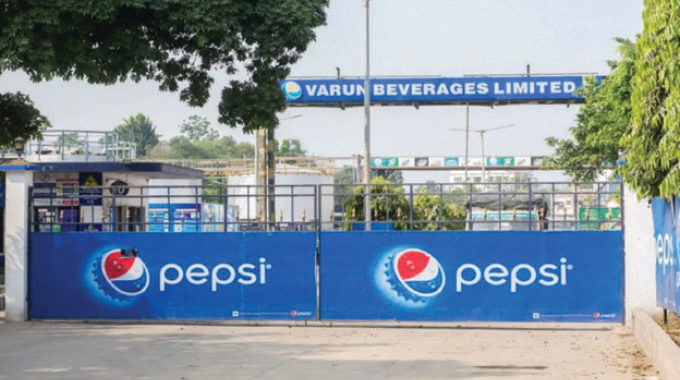
PEPSI bottler, Varun Beverages, has emerged as the leading prospective buyer for a controlling stake in Zimbabwe’s largest dairy and food processor, Dairibord Holdings Limited.
This follows a cautionary statement issued by the Dairibord board, which advised shareholders that three of its major blockholders — Equivest Asset Management, Mega Market and Mutare Mart & Exchange — had issued a joint notice disclosing that they had entered into negotiations with an unnamed third party to sell their collective shareholding.
Combined, the three entities hold a commanding block of shares representing over 51 percent of Dairibord’s issued ordinary shares, meaning that if successful, the transaction will result in a total change of control.
Mega Market is the largest shareholder in Dairibord, holding a 23,92 percent stake. This is closely followed by Stanbic Nominees, which holds 23,87 percent of the company.
Serrapin Investments is the third-largest shareholder with 12,04 percent, while Old Mutual Life Assurance Company Zimbabwe Limited holds a 10,65 percent shareholding.
The Mining Industry Pension Fund rounds out the top five, holding 4,93 percent of the total stock.
The top five shareholders own 75,41 percent of Dairibord, leaving the remaining 24,59 percent in the hands of other, smaller retail and minority investors.
While the official cautionary statement did not name the buyer, market intelligence strongly points to Varun Beverages positioning itself to take over the dairy giant.
“A few potential buyers are being mentioned, but Varun Beverages has come out as the leading contender,” said a source speaking on condition of anonymity because they are not permitted to talk to the Press.
Market sources, however, indicated that Varun has quietly been buying up smaller tranches of shares from open-market holders.
Another source familiar with the developments said that while Varun reportedly expressed interest in a control stake, no formal communication has been made with Dairibord management.
The source also said the stake available to Varun was still below 51 percent and the beverages giant has been mopping up shares from the open market.
Another source, however, said Varun was not the only buyer looking for a controlling stake in Dairibord.
“There are also other players being mentioned,” said the source.
Varun is an Indian-headquartered multinational and one of the largest franchise bottlers of PepsiCo products in the world outside of the United States.
The company manufactures, bottles and distributes a massive portfolio of beverages, including Pepsi, Mirinda, Mountain Dew, 7Up and Aquafina.
Varun officially entered the Zimbabwean market in 2018 with the launch of a state-of-the-art greenfield bottling plant in Harare.
Since its entry, the company has hugely disrupted the local beverage landscape through an aggressive low-cost pricing model, rapid capacity expansions and an extensive, highly visible retail distribution network.
Beyond beverages, Varun has begun expanding into the food and snacks sector — having secured a licence to manufacture and distribute PepsiCo snack brands, such as Simba Munchiez.-herald
‘We should embrace AfCFTA or risk being left behind’
Retreating from the dictates of the African Continental Free Trade Area is no longer an option for Zimbabwe, a senior Government official has warned.
This, however, comes amid concern from industry leaders that indiscriminate opening of borders, without sound industrial infrastructure, could reduce the local economy to a mere “supermarket” for foreign goods.
Ministry of Industry and Commerce acting director for industrial development, Ms Ruvimbo Sandauke, said that because Zimbabwe had already signed and ratified the continental trade pact, the country had moved into the implementation phase.
However, she acknowledged that entering the free trade zone without first correcting deep-seated domestic bottlenecks poses a severe threat to local industry.
“If we go without fully addressing the cost drivers for all our sectors, we run the risk of being a supermarket, where we open borders for products to just come in from everywhere,” Mr Sandauke said during the Mid-Term Economic Review and High-Level Policy Dialogue in Harare recently.
Initiated by the African Union (AU) as a flagship project of Agenda 2063, the AfCFTA is designed to create the world’s largest free-trade area by number of participating countries since the establishment of the World Trade Organisation.
The trade pact aims to connect over 1,3 billion people across 54 participating African nations with a combined gross domestic product (GDP) exceeding US$3,4 trillion.
Historically, intra-African trade has been highly fragmented, accounting for only about 16 percent of the continent’s total trade — a contrast to about 59 percent in Asia and 68 percent in Europe.
The AfCFTA, which officially commenced preferential trading in January 2021, aims to transform this landscape by progressively eliminating tariffs on up to 97 percent of goods and systematically dismantling non-tariff barriers.
However, the agreement is exposing deep disparities in industrial readiness.
For countries like Zimbabwe, the rapid liberalisation of trade is forcing an immediate reckoning with high local utility, regulatory and production costs that make domestic goods highly vulnerable to cheaper, more efficient regional competitors.
To a potential negative impact on local industry, Ms Sandauke said that the Government was shifting towards accelerated, multi-stakeholder engagements to systematically dissect and streamline regulatory costs and other operational burdens.
She said the Ministry of Industry and Commerce was currently working alongside the Ministry of Agriculture, Mechanisation and Water Resources Development to target 15 integrated agro-value chains, including dairy.
“What is critical is that we need to have a round table around the sector,” Mr Sandauke said.
“Let’s have engagements, try to streamline, and identify at a granular level what is pushing these costs.”
The Government’s policy push comes in direct response to acute anxieties raised by industrial captains at the policy dialogue, hosted by Africa Economic Development Strategies.
Zimbabwe Dairy Industry Trust chairman Mr Temba Mutsvairo expressed deep concern over the local dairy sector’s readiness for continental competition, pointing to severe structural inefficiencies that leave domestic processors uncompetitive against regional peers.
“In the dairy sector, I don’t think we are as yet ready for that,” Mr Mustvairo said. “Our cost of production is too high compared to the regional parity.”
He said Zimbabwean processors were currently forced to buy raw milk from local farmers at a steep 63 cents per litre — a price heavily inflated by local cost factors.
This baseline cost makes the final product on domestic supermarket shelves significantly more expensive than milk across Zimbabwe’s borders.
“If the borders are open before we address the local cost of production, we run the risk of affecting the whole dairy value chain,” Mr Mustvairo warned, adding that local processors would be unable to compete against an influx of cheaper imports.
He called on policymakers to centre future economic strategies around reducing the unit cost of production to safeguard local business viability and stimulate future exports.
facebookShare on Face-herald