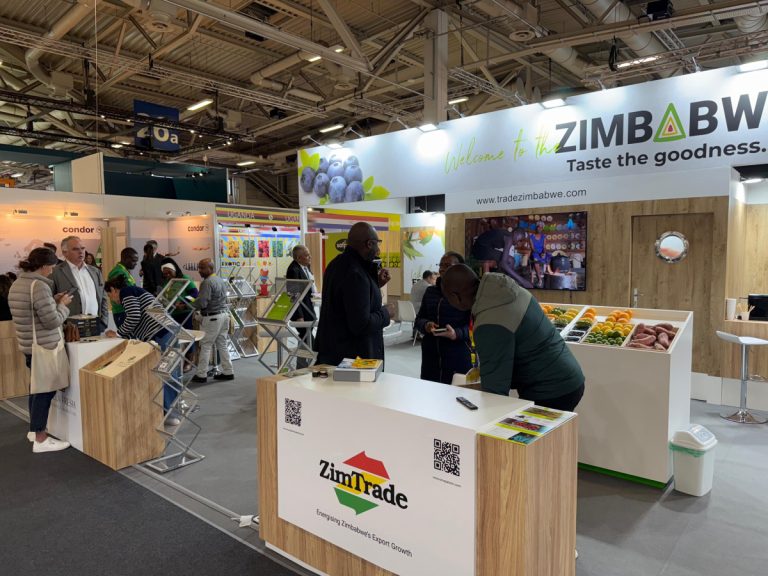
On the bustling floor of Fruit Logistica, amidst a global panorama of fresh produce, the Zimbabwean stand stands out. It is the second day of the prestigious trade fair, and the atmosphere here is one of quiet confidence and tangible ambition.
The participants are not only here to secure orders for their own companies but to champion a transformative agricultural movement unfolding back home: the empowerment of smallholder farmers.
At the heart of this mission is Takura, represented by its director, Mr William Zirebwa.
“Takura is now a fully-fledged registered company,” Mr Zirebwa explains, standing proudly by displays of vibrant produce. The enterprise began with support from Unki Mine, now part of Valterra Platinum, but its vision is distinctly its own.
“Our mandate is to improve livelihoods within our communities, and we see horticulture exports as something which can help accelerate that goal.”
Takura’s model is a sophisticated outgrower scheme currently supporting around 200 smallholders in the Shurugwi and Gweru areas, with plans to expand to a thousand. Crucially, 70 percent of these farmers are women.
“We look at gender lenses,” Mr Zirebwa notes.
“Horticulture allows them to do much better. We allocate about 0,1 hectare to a farmer, needing 5 people for the activities, and they can make a net profit of over a thousand dollars in four months. With three cycles, that’s transformative income for a communal farmer.”
The system is designed for accessibility and sustainability.
“We raise finance for inputs, so the farmer does not have to worry. We replicate the tobacco model but with communal farmers,” he says.
Takura’s technical team ensures standards are met, and the company handles complex logistics, with farmers repaying the costs at harvest. This support is backed by one of Zimbabwe’s largest purpose-built pack-houses, capable of handling 50 to 100 tonnes of produce weekly. “The vision,” Mr Zirebwa asserts, “will not be achieved through mining but through agriculture.”
This focus on smallholders is a unifying thread among the Zimbabwean exhibitors. Mr Clarence Mwale, chief executive officer of Kuminda, speaks with passionate conviction about another high-value crop: blueberries.
“Everyone was against small-scale farmers growing blueberries. We’re the only ones that believe we can do it — and we’re doing it.” Kuminda is pioneering a model partnering with smallholders, already securing a niche as Zimbabwe, with its favourable climate, becomes the first southern hemisphere producer to enter the European market each season.
“We are proving wrong the view that nothing will come from the small scale. We are setting the pace in Africa.”
Meanwhile, Ms Dephin Mbanje, farm administrator for Avomac, details their work aggregating produce from outgrowers, particularly targeting widows and child-headed families for macadamia nuts and avocados.
“We help them grow their plantations and market their products,” she says.
The challenge, she notes, is often scale and certification. Her advice to other smallholders is to unite. “Have a united front to meet minimum orders. There is high demand for so much — avocados, macadamias, citrus, even horn melon (gaka). We must align our vision.”
The Zimbabwean presence, coordinated by ZimTrade and the Ministry of Foreign Affairs and International Trade, is in its 5th consecutive year at the fair. Zimbabwe’s Ambassador to Germany, Ms Alice Mashingaidze, underscores the strategic aim.
“We are engaging and re-engaging markets to create sustainable outlets for our produce and attract investment,” she said following her tour of the Zimbabwe Pavilion on Tuesday. “We have 12 exhibitors here, and they are seeing great potential. This is about achieving our national Vision 2030 through the horticulture sector.”
The strategic framework enabling this national effort is explained by Kudakwashe Tirivavi, a client advisor for the national trade development and promotion organisation, ZimTrade. “ZimTrade operates under four pillars: export development, export promotion, market intelligence, and advocacy,” he says.
“Under export development, we have cluster programmes where we integrate smallholder farmers into exports. We do this using aggregators or off-takers.”
He details the critical role these partner companies play in bridging the gap between the farmer and the complex global market. “We work with aggregators to develop the smallholder farmer in terms of agronomy and technical handling, from pre-planting to post-harvest.
The aggregator then handles everything from cold chain to treatment and logistics for air or sea freight.
“A smallholder farmer often lacks direct market access, internet connectivity and the capital for the logistics. Their best route to export is through a partner with the resources and technical capacity,” Mr Tirivavi explains.
This model is brought to life by the exhibitors present. “Companies such as Kuminda, Eden Chase, Procitru and Cicada have that export capacity. They do the aggregation, sorting and grading and are responsible for delivering the produce to the final market.”
As day two progresses, the stand buzzes with meetings between buyers, investors and the Zimbabwean delegates.
The critical role of structured, long-term support is underscored by Ms Karen Jiri, commercial director of Cicada, who details an innovative three-year training programme for smallholders.
“We have training centres in Karoi and Honde Valley,” she explains. “We take the farmers through a three-year programme. The first year, they grow maize with us, and we work with them to establish the principles of regenerative or conservation agriculture.”
This foundational year ensures food security and sustainable practice. Success leads to the second year, where a high-value crop like coffee is introduced. “Then, in the third year, when they’ve demonstrated an ability to repay their inputs, they graduate into avocados. We give them free seedlings and monitor their performance.”
Recognising the long maturity cycle of avocados, the programme concurrently creates a vibrant local ecosystem. “They also do wheat, and we buy from them, selling them to commercial bakeries. We even buy their maize for our own operations’ canteens. It’s about creating an ecosystem with the surrounding communities.”
Adding a powerful dimension to this narrative of inclusive growth is Ms Valerie Madziva, sales and marketing manager at horticultural producer Eden Chase. “We are a company that is mainly into melon production and blueberries, and we aggregate for small-scale farmers,” she explains.
Eden Chase’s work extends beyond traditional farming communities to some of the most marginalised groups. “Currently, we’re working with refugee camps like Tongogara Refugee Camp.
“We also have small-scale farmers based in Gwanda who use irrigation to produce melons. Our main goal is to elevate the livelihoods of small communities so that they can have foreign currency and be able to sustain their families.”
The story they tell is not merely of quality produce — organic, ethically grown and competitively presented — but of a profound commitment to inclusive growth.
They are building more than export lines; they are building livelihoods, one smallholder farmer at a time and from the communal lands of Zimbabwe to the global stage in Berlin, their message is clear: the future of Zimbabwean horticulture is rooted in its people.-herald