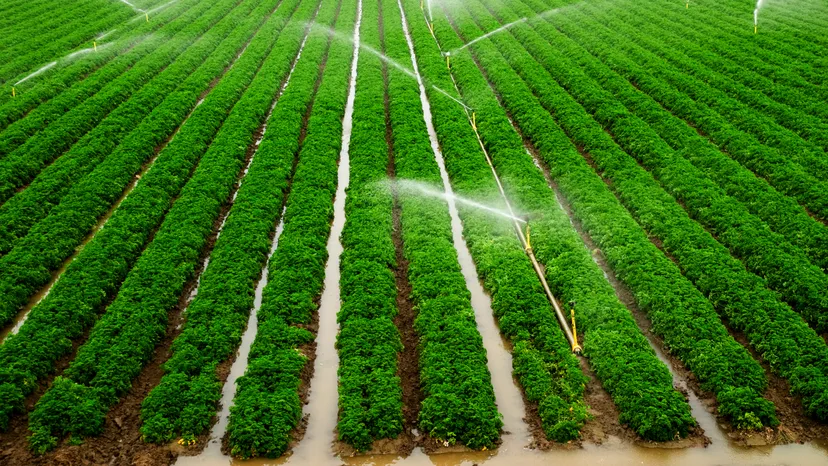
Zimbabwe should enhance national irrigation development to boost agricultural productivity, ensure food security and cushion the sector from climate change, a senior Government official has said.
Lands, Agriculture, Fisheries, Water and Rural Development Minister Professor Obert Jiri said the country had adequate water resources that should be fully utilised to support agricultural production, especially cereal crops, in light of growing climate variability.
Zimbabwe’s irrigation development focuses on reducing rain-fed agriculture reliance through major programmes like the National Accelerated Irrigation Rehabilitation and Development Programme (NAIRDP), the Smallholder Irrigation Revitalisation Programme (SIRP) and public-private partnerships (PPPs) under the Irrigation Development Alliance.
“On 5 July 2024, during the irrigation Investment Indaba, we started on a path where we said, let’s convert all water bodies to irrigation. We have more than 10 700 water bodies in the country and the irrigation potential is for over two million hectares.
“Currently, we are sitting on 233 000 hectares, which is not enough to produce the cereal food that we need. If we can have at least 350 000 hectares assigned to the production of cereals, we will be able to produce more than enough food.”
He said irrigation remained central to safeguarding national food supplies against droughts and erratic rainfall patterns.
“Therefore, the irrigation thrust is key to climate proofing. We are rehabilitating irrigation schemes and constructing new ones. The water bodies should not be white elephants; water must be utilised for irrigation and that is the thrust where we are inviting investors to utilise the water for production.”
Prof Jiri said irrigation development had benefited significantly from partnerships with development agencies and private investors.
“Our development partners have really come through for us. In terms of irrigation rehabilitation, the bulk of the progress we have seen was driven by development partners and our investors.”
To strengthen coordination and fast-track irrigation expansion, the ministry established the Irrigation Development Alliance.
The Irrigation Development Alliance is a Government-facilitated framework, often involving the private sector and designed to boost agricultural productivity by accelerating investment and development in irrigation systems.
“We formed the alliance to ensure that everyone involved comes together at one table to think together, plan together, and determine what we can do in irrigation,” said Prof Jiri.
He said the Government’s strategy is to stimulate agricultural growth through a private-sector-led investment model, with the State playing a supportive role.
He said the thrust was to drive growth in agriculture and ensure a private-sector-led investment model, with the Government only playing the role of an assistant.
Prof Jiri said the ministry had initially set a target of a US$5 billion agricultural industry by 2025 and managed to achieve and surpass it by 2023,” he said.
“After exceeding the US$5 billion mark two years early, the ministry revised its projection to US$8,2 billion. We achieved that as well, and in fact attained more than a US$10 billion industry as we crossed into 2025,” said Prof Jiri.
He said the sector’s strong performance had prompted the setting of even more ambitious targets.
He noted that the new target reflects the sector’s proven ability to achieve accelerated growth.
“We have now set our sights on surpassing US$15,8 billion by 2030 because the sector continues to deliver beyond expectations,” he said.
The up-scaling of irrigation, Prof Jiri said, would be critical in sustaining this growth trajectory, enhancing productivity, creating employment and positioning agriculture as a key driver of Zimbabwe’s economic development.
According to the 2026 national budget, the Government continues to invest in irrigation rehabilitation and development to mitigate increasing incidences of climate shocks, to ensure food security at the household and national level through the National Accelerated Irrigation Rehabilitation Programme.
The aim is to ensure that the country’s irrigation potential is fully exploited with a target to increase functional irrigable land to 350 000 ha by 2030.
“The 2026 National Budget will, therefore, pursue measures aimed at upscaling irrigation and water harvesting infrastructure development in semi-arid regions.
“ In this regard, the budget is setting aside ZiG823,8 million towards irrigation development with priority being given to ongoing irrigation schemes,” reads part of the document.
Finance, Economic Development and Investment Promotion Minister, Professor Mthuli Ncube, said the Government would also promote Public Private Partnerships under the auspices of the Irrigation Development Alliance.
The initiative targets 37 000 ha and other Joint Ventures, including the ARDA VIAM Wholesale Model, which are expected to contribute a further 17 000 ha in 2026.
This strategic commitment aims to reduce the country’s dependence on increasingly erratic rainfall, transforming food security from a vulnerability to a resilient strength.
-herald