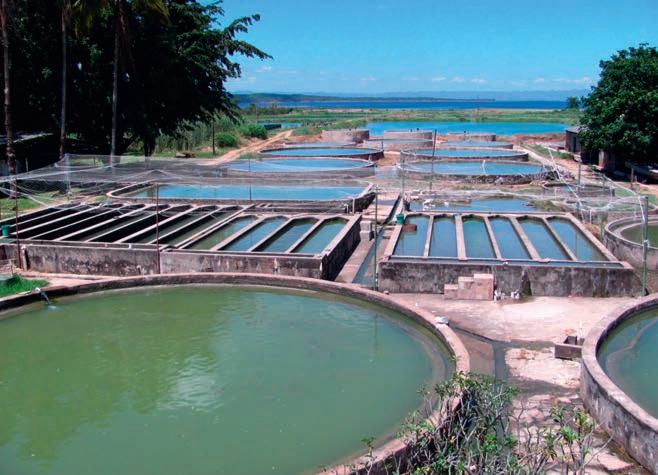
Zimbabwe should capitalise on its 10 000 dams scattered across the country to meet the national demand for fingerlings and achieve its fish production targets, a Cabinet minister has said.
The country produces 31 000 tonnes of fish against the national demand of 60 000 tonnes annually, while there is also a significant shortfall of fingerling supply.
Zimbabwe is targeting to grow its aquaculture sub-sector to a US$1 billion industry by 2026. Officially launching the hatchery management guidelines in Bulawayo, Lands, Agriculture, Water, Fisheries and Rural Development Deputy Minister Davis Marapira called for increased efforts to meet the demand for fingerlings and fish.
“Zimbabwe is looking at a US$1 billion economy out of fisheries, but we do not have fingerlings,” he said.
“For us to reach the US$1 billion economy, we only need 200 000 females. So that is the focus and the vision of this launch production of hatcheries, which are going to be allocated to provinces. We only have six breeding places, but we need to decentralise them to districts,” he said.
He said the Government and the Food and Agriculture Organisation, an arm of the United Nations, came up with voluntary hatchery guidelines to direct the production of quality fingerlings at all hatcheries.
The deputy minister said this led to the drafting and finalisation of the Voluntary Hatchery Guidelines by various stakeholders from across the aquaculture sub-sector.
“To address the challenge of availability and accessibility of quality fingerlings, the Government launched the Technical Cooperation Programme (TCP) right here at the site of the Matopos Fisheries Unit sometime last year.
“Under this programme, the Government of Zimbabwe, in collaboration with FAO, agreed to work together to boost fingerling production by establishing five decentralised fish breeding sites across the country,” he added.
“I am pleased to report that three out of five targeted breeding sites have been established at Henderson Fisheries Unit in Mashonaland Central; solarised, with one borehole and aquaroom, and stocked with 1 735 Nile Tilapia breeding stock.”
He said at the Makoholi Fisheries Unit in Masvingo Province, five fishponds had been constructed, a biosecurity fence installed and solar borehole equipment procured, while breeding stock would be introduced by the end of November.
Deputy Minister Marapira said at the Matopos Fisheries Unit in Matabeleland South, where five fishponds have been constructed, 525 male and 140 female fish breeders have been stocked.
“To further enhance fingerling production at these breeding sites, the Government has also come in to drill boreholes across all sites, ensuring adequate water supply. Three boreholes have been drilled at the Matopos Fisheries Unit, where one of the three boreholes has already been solarised and was fully equipped under the TCP,” he said.
“We are optimistic that by mid-December 2025, we will begin producing fingerlings, ensuring that high-quality, certified fingerlings are produced and distributed across the country, supporting farmers and strengthening our fisheries and aquaculture value chain.”
He said once fully operational, the combined breeding sites will be capable of producing up to 10 million fingerlings per annum before further expansion, a major boost to our national fingerling supply chain.
The deputy minister said more still needs to be done to meet the projected demand of 150 million fingerlings in the sector for Zimbabwe to attain a US$1 billion fisheries and aquaculture economy.
I am encouraged by the growing interest and involvement of private hatcheries in complementing Government efforts in fingerling production, with most hatcheries here present indicating their willingness to upscale their fingerling production to help meet this deficit,” he said.
“As Government, we understand that to truly meet our national fingerlings demand and fish production targets, we must decentralise breeding operations and increase the ease of accessibility of quality fingerlings across the country.
In a speech read on behalf by FAO monitoring and evaluation supervisor, Mr Tendai Mugara, the FAO Zimbabwe representative, Dr Patrice Talla Takoukam, said they were ready to continue their collaboration with the Government, guided by science imperatives, driven by communities and anchored in the belief that no one should be left behind.
“Over the past five years, FAO has walked this journey with Zimbabwe from the foundational work of FISH4ACP to the targeted interventions under the Technical Cooperation Programme (TCP)/ZIM/3907.
“Together, we have worked on strengthening legal frameworks (through development of the Fisheries and Aquaculture Bill), organised producers into cluster farmers by providing technical support to the projects under their leadership, enhanced production systems (through building capacity in farming, and enabling access to quality genetics), and building institutional capacity,” he said.
“The launch of these guidelines is a testament to what can be achieved through partnership, persistence and shared purpose. We reaffirm FAO’s commitment to supporting Zimbabwe’s vision for a resilient, inclusive and sustainable aquaculture sector.”
He said the Hatchery Management Guidelines, developed through the Technical Cooperation Programme in close collaboration with the Fisheries and Aquaculture Resources Department (FARD) of the ministry, were a direct response to these challenges.
-hrald