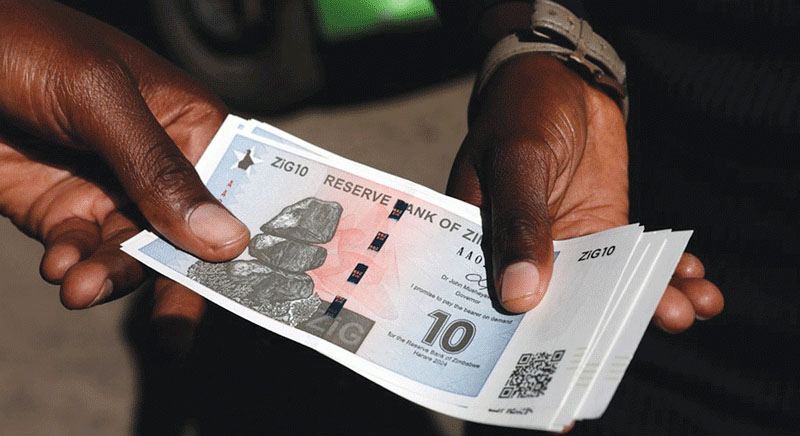
For example, the excitement that the Zimbabwe economy may grow by 6,6% in 2025 fails to measure or explain the quality of that growth and its true social impact.
IT is very important that we all understand some of the economic tools which seek to measure development and whether these tools are useful at all.
The current raging debate on the income status level of our economy shows that we need some clarity on what exactly is being measured, whether that measurement is appropriate and is a true reflection of conditions on the ground.
We all know that the economy is failing to meet the needs of many as poverty is increasing, especially in the urban sector and yet some are claiming that things are improving.
There is, of course, also the issue of our national vision of being an upper-middle-income economy by 2030, which to me remains vague and unlikely given the lack of a fundamental re-think of our economic policies.
First, I think some economic measurement tools become inadequate where you want to measure the quality of life of citizens in general.
I have always maintained that GDP, for example, is a meaningless measure especially if you seek to eradicate poverty because it does not deal with income or wealth redistributive issues.
For example, the excitement that the Zimbabwe economy may grow by 6,6% in 2025 fails to measure or explain the quality of that growth and its true social impact.
For me, it merely tells us the direction in which the economy is going, but does not deal or address with pressing social issues such as high unemployment levels, increasing poverty in both rural and urban sectors and the need to eradicate poverty in general.
In other words, despite an increase in GDP, life conditions can actually get worse for the ordinary citizen.
Advertisements
In a dualistic and monopolistic economy such as Zimbabwe, where we have concentrated ownership of capital and limited ability to accumulate wealth for many, an increase in GDP merely results in further concentration of ownership of the economy in fewer hands while the poor become poorer.
That is not progress at all.
GDP may grow, but that does not necessarily indicate an improvement in the well-being of most citizens and that has been the case in many African economies.
Most citizens are not feeling that growth at all.
We can then talk about the per capita income measure, which derives from GDP.
In this case, you are merely dividing your total GDP with the population to get a number, per capita income, which is further used to determine whether an economy is growing.
Again, here we have a measure that fails to reflect the actual conditions on the ground.
An increase in per capita income does not necessarily mean that poverty is reducing and the economic conditions of citizens are improving.
In fact, the opposite can be true.
According to the World Bank, a lower middle-income economy has per capita income range from US$1 136 to US$4 465 while an upper-middle-income economy has a range from US$4 466 to US$13 845.
However, lower- or upper- middle-income economies have other characteristics which are necessary, meaning it’s not only about the income levels.
Therefore, saying the Zimbabwean economy is lower middle or upper middle income without taking into consideration these characteristics is highly misleading and somewhat mischievous.
What are these characteristics?
The other necessary characteristics of an economy to be classified as lower middle-income include:
Growing industrial and services sectors with high employment creation as these increase disposable incomes;
Improving infrastructure and education levels. Infrastructure includes connectivity, consistent power, developing roads and rail networks, improving water reticulation and sanitation, improving public utilities and better access to health and education;
An emerging middle class as a result of decent jobs and secure employment, improving disposable incomes, savings, increasing local aggregate demand;
There is limited access to advanced technologies and capital; and
The economy still faces poverty and inequality issues.
Note that Zimbabwe, Kenya and Nigeria are classified as lower- middle-income economies.
The facts are that Zimbabwe has been in this bracket for the last 45 years since independence, while China, whose per capita income was lower than that of Zimbabwe’s in 1980, has grown 13 times in the same period, making it an upper-middle-income economy.
To me, this says whatever we have been doing for the last 45 years is not working to improve incomes and quality of life of citizens.
Zimbabwe barely qualifies as a lower-middle-income economy because it does not have a vibrant middle class or increasing disposable incomes, has a dilapidated infrastructure, is dominated by the informal sector, has increasing poverty and inequality while the industrial sector is diminishing.
In the case of upper-middle-income economies, the other characteristics, besides per capita income levels, include;
A strong diverse economy with a strong industrial base and services sector backed by increasing value-added exports;
Increasing urbanisation with high demand for housing, transport and utilities;
A rising middle class with improving consumer spending and high access to health and education facilities;
High levels of local and foreign investment with a strong private sector; and High literacy rates and life expectancy and better access to services.
China, South Africa and Brazil are classified as such and Zimbabwe aspires to be such an economy by 2030.
We can now start having informed and relevant debate on the subject matter of the per capita income measure.
The key issue here is that, per capita income levels alone are not the only measure whether an economy is lower- or upper- middle-income economy.
Zimbabwe, despite being a lower-middle-income economy since 1980, has much I to do to address all the other characteristics as described above.
Second, the vision 2030 of becoming an upper-middle-income economy cannot and must not be measured by merely dividing our GDP by the total population, but by measuring all the other necessary characteristics of a typical upper- middle-income economy as described above.
We have been stuck as a lower-middle-income economy for 45 years and are actually regressing and we are seeking to be an upper-middle-income economy within five years without fundamentally changing what we have done for the last 45 years.
In my opinion, doing the same thing and expecting different outcomes is termed insanity, but I choose call it mere tomfoolery. -newsda